
Spatial imaging refers to images or videos generated through reconstruction technologies that support multi-degree-of-freedom viewing and interaction. As an upgrade from today’s mainstream two-dimensional imaging, spatial imaging can capture and record richer visual and auditory information, convey deeper emotional expression, and allow users to explore objects and scenes more immersively from multiple perspectives, including six degrees of freedom such as translation and rotation. This opens up new possibilities and application prospects for social media sharing, e-commerce product display, map-based lifestyle services, architecture, industry, and many other fields.
In recent years, reconstruction technologies represented by 3D Gaussian Splatting, or 3DGS, have developed rapidly, enabling ordinary consumers to use lightweight terminals such as smartphones to complete high-quality reconstruction at low cost and with high efficiency, while also supporting real-time rendering and interactive browsing on the device side. However, the industry currently lacks a unified exchange format for spatial imaging. The packaging, encoding, and decoding methods adopted by different manufacturers are not compatible with one another, making it difficult for spatial imaging files to be shared across different devices and applications. This also increases the complexity of third-party ecosystem adaptation and may lead to ecosystem fragmentation.
To address these challenges, the UHD World Association (UWA), joined hands with more than 20 partners from industry, academia, and research institutes to establish a spatial imaging standards project group. The group has also maintained technical coordination with the 3D Formats Working Group of the Khronos Group, an international standards organization. After more than a year of requirement discussions, technical solution development, testing, and verification, and in consideration of current industry conditions and future development needs, the project group jointly developed the standard Three-Dimensional Image Format Supporting Six-Degrees-of-Freedom Interaction.
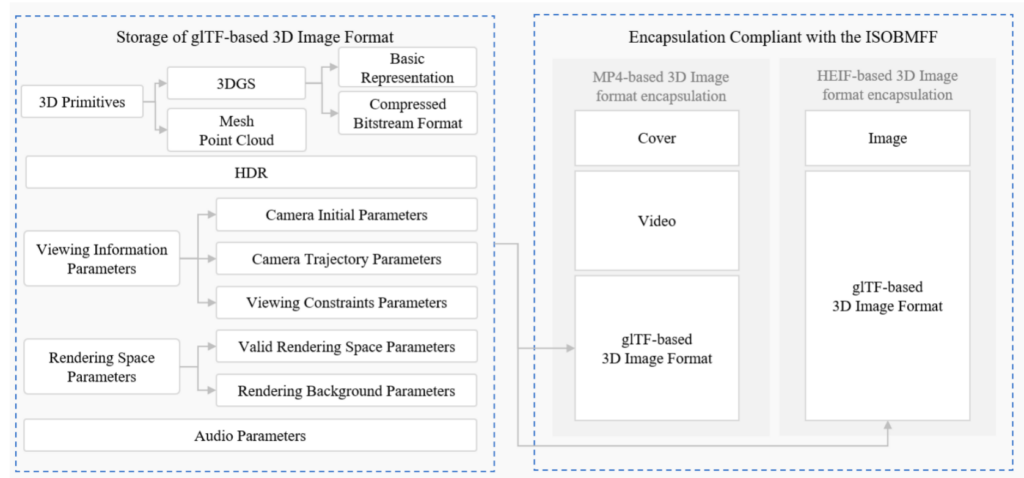
Framework of the Three-Dimensional Image Format Supporting Six-Degrees-of-Freedom Interaction
The standard features industry-leading technical capabilities:
- Efficient compression
The standard provides EGSC, or Efficient Gaussian Splatting Codec, a 3DGS encoding and decoding solution that supports variable bitrates. Under the premise of visually lossless viewing on mobile devices, EGSC delivers an average compression ratio of 20x and up to 30x, achieving industry-leading performance. EGSC makes full use of the hardware encoding and decoding capabilities of mainstream devices, enabling fast encoding and decoding. For one million Gaussians with 0–3 order SH, encoding takes less than 4 seconds and decoding takes less than 400 milliseconds. It also reduces graphics memory usage during rendering, equivalent to approximately 50% to 75% of the original file size. - Flexible extensibility
The standard stores 3DGS based on glTF, while remaining compatible with traditional 3D representations such as meshes and point clouds. It also extends support for features including audio, HDR, and viewing constraints. - Ecosystem-friendly design
The standard supports outer-layer packaging based on ISOBMFF, including MP4 and HEIF. This enables 3D scenes in glTF format to be encapsulated into MP4 or HEIF files, reusing existing media-format storage and sharing channels.
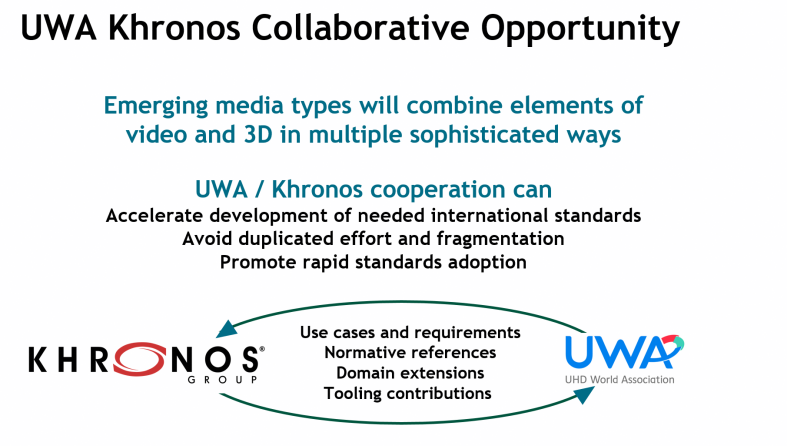
Taking the Three-Dimensional Image Format Supporting Six-Degrees-of-Freedom Interaction standard as a starting point, UWA has entered into a strategic partnership with the Khronos Group. Together, the two organizations will work to develop globally unified standards for spatial imaging technologies and expression formats represented by 3DGS, helping avoid duplicated efforts and fragmentation while supporting the large-scale development of the spatial imaging industry and building a unified global ecosystem. The two parties have jointly launched the CKAP China Graphics Working Group to promote standards coordination and ecosystem co-development through standard requirement input, references to the KHR_Gaussian_Splatting extension, standard development, and tool contributions.
UWA and its industry partners will develop a series of open-source tools around this standard, including packaging and unpacking tools, codecs, renderer reference tools, and source code. They will also continue discussions on the future evolution of spatial imaging standards, promote industrial implement