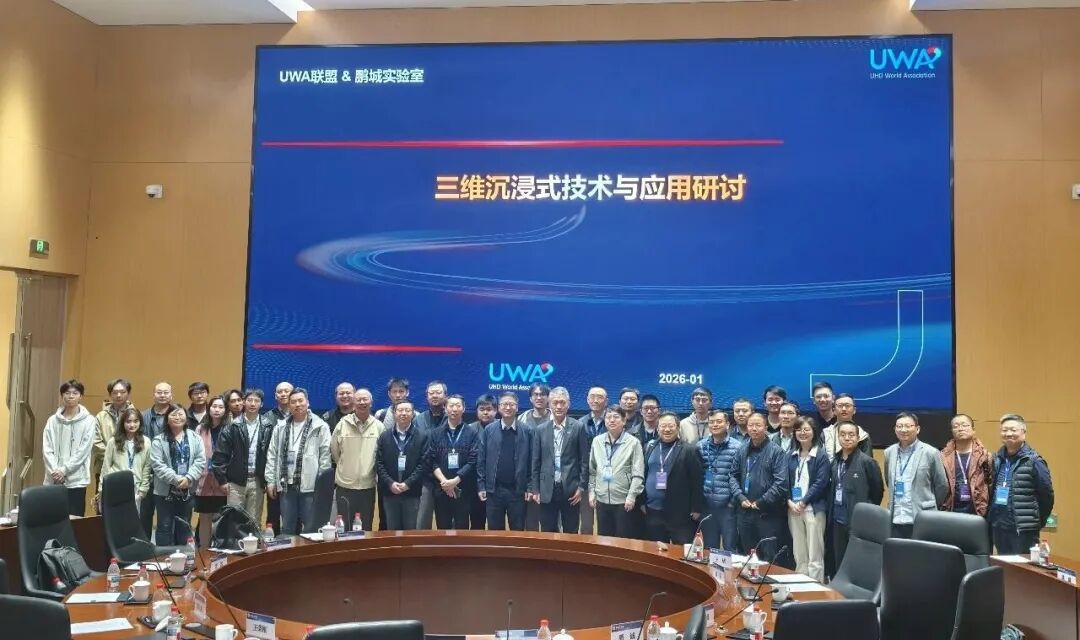
To further promote the integrated development of UHD and 3D immersive media industries, PengCheng Laboratory and the UHD World Association (UWA) recently co-hosted the “3D Immersive Media Technology and Applications Seminar” in Shenzhen.
The seminar featured in-depth exchanges and discussions on key technologies, standardization, application scenarios, and industrial ecosystems related to 3D immersive media.
More than 50 expert representatives from across the industry value chain attended the event. Participating organizations included PengCheng Laboratory, China Media Group (CMG), Huawei, China Mobile Migu, TCL, HiSilicon, Mango TV, ZTE, Tencent, Konka, HONOR, OPPO, VIVO, Insta360, Malanshan, LUSTER LightTech, Shenzhen Media Group, FiberHome, Sikai Garden, QingTong, Tusheng, Bohui, among others.
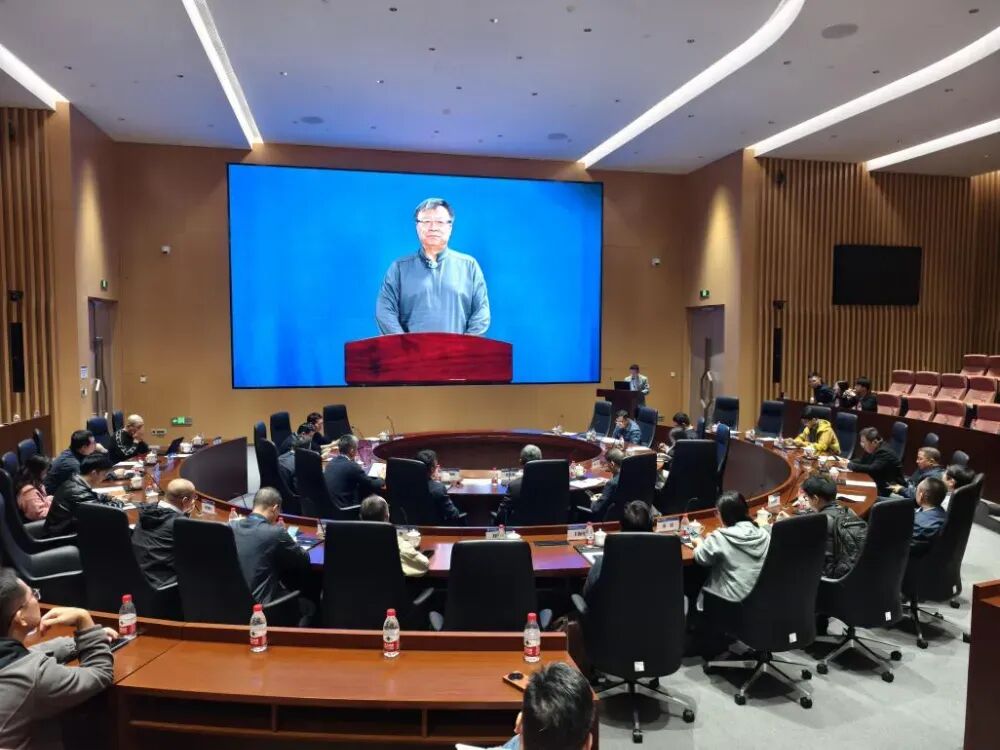
Gao Wen, Academician of the Chinese Academy of Engineering and Director of Peng Cheng Laboratory, delivered a video address. He noted that, as a national strategic scientific and technological force, Peng Cheng Laboratory is committed to building a national-level computing power platform and has long been deeply engaged in video coding as well as 3D immersive technologies and applications. He called on the industry to form a united force and “work together to grow and strengthen the 3D immersive technology and application industry.”
Vincent Zhang, Secretary General of the UWA, reviewed the association’s work to date in the field of 3D immersive technologies and applications. He emphasized that, as an industry organization, the core mission is to address real industrial challenges and promote the implementation of technologies, forming a complete industrial closed loop.
Wang Ronggang, Director of the Intelligent Coding Institute of the Media and Interaction Department at Peng Cheng Laboratory, systematically elaborated on the development path and frontier breakthroughs of 3D immersive media. He pointed out that immersive communication for 6G is a key driving force, and that 3D video technology is continuously evolving along a trajectory from stereoscopic vision and multi-view video to panoramic media, free-viewpoint video, and ultimately holographic video.
Currently, the industry still faces challenges such as high content production costs, massive data volumes, and difficulties in real-time processing on mobile devices. He highlighted the laboratory’s breakthrough progress in 3D video coding technologies, which can achieve compression efficiencies of up to several thousand times. Under the same visual quality, the bitrate can be reduced by approximately 90% compared with the latest international standards. Real-time interactive verification has already been completed on mobile devices, and corresponding chip prototypes have also been developed. He further noted that future media formats will evolve toward a multimodal paradigm, with video as the foundation, integrated with spatial audio, haptics, and physical attributes.
Experts attending the seminar generally agreed that 3D immersive media is at a critical stage of transitioning from technological breakthroughs to large-scale applications. Its development should be driven by application scenarios and supported by a robust ecosystem, enabling the coordinated evolution of technology, content, terminals, and business models. Establishing dedicated working groups to collaboratively advance industrial development was considered essential.
During the discussions, industry experts actively exchanged views, focusing on the following areas:
At the technical level, continued iteration of core technologies is required, along with the establishment of a standards system aligned with industrialization progress. At the content level, production guidelines, toolchains, and new technologies should be integrated to lower barriers to creation. At the terminal and consumer level, user habits should be cultivated through AR/VR/MR devices, smartphones, tablets, and televisions to ensure high-quality experiences. At the application and commercial level, continued focus on sports broadcasting is encouraged, alongside active expansion into diversified fields such as gaming, digital humans, e-commerce, mapping, and spatial intelligence, potentially through a phased development approach.
Following the seminar, a “3D Media” specialized working group, to be established under the UWA, will set up a regular communication mechanism and organize periodic thematic seminars. The group will jointly promote key technology iteration, standard development, demonstration applications, and industrial deployment, systematically addressing development bottlenecks and accelerating the growth of the industrial ecosystem.